When my brother was killed in the June 16th student uprising, he was just a 13 year old school boy. But this does not justify the heroism around him as a martyr […] I appreciate that my brother is honored as the icon of the uprising against the Apartheid Government’s decision to enforce Afrikaans as medium of instruction in black schools. He was an ordinary child without glamour. Why the glamour around his death?
Antoinette Sithole
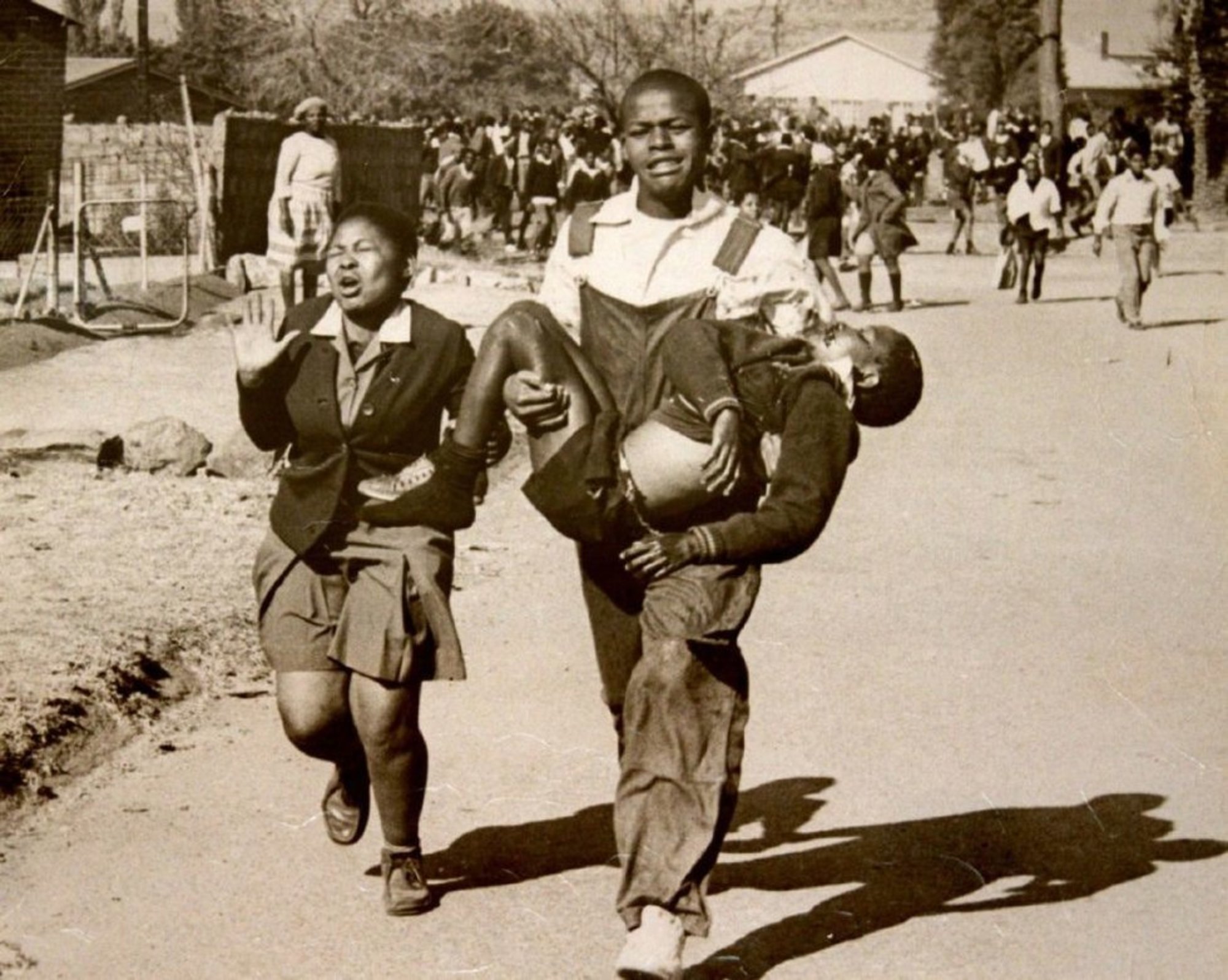
The iconic photograph of Mbuyisa Makhubu carrying Hector Pieterson’s dying twelve year old body is enough to be the most compelling image in the Hector Pieterson Museum. Antoinette Sithole running alongside the pair of boys as an outrider, further underscores the impact. Although it was not the first time that I had seen Sithole’s grief stricken face contorted in an agonized grimace, it was the first time I viewed the photo on the soil where her brother was dispossessed of his body. I was verklempt. Yet, it was Sithole’s words beneath the photograph that impelled me to focus on the installment longer than I did any other item in the museum.
I ruminated on the words ‘martyr,’ ‘heroism,’ ‘death,’ ‘black’ and ‘glamour’ and wondered why are Black men and women across the globe dispossessed of their bodies in the name of equity? Why the glamorization of their deaths when the right to life should be guaranteed. I thought of other martyrs whose deaths, like Pieterson’s, were deemed heroic: Cuffy, Reverend George Lee, Lamar Smith, Medgar Evers, Steven Biko, Malcolm X, Martin Luther King Jr., to name a few. I appreciate the honoring of black martyrs and the sacrifices they made for the community, but often question why the glamorization of their deaths. As a sister, I could not avoid thinking about my own siblings at Pieterson’s age. Even as adults, I still feel protective of my brothers and male cousins.
Still cogitating on Sithole’s quote’s and feeling like a smorgasbord of emotions, I thought of Makhubu. Though Pieterson was a stranger, he carried him like a brother. Makhubu declared that stepping over Pieterson’s body would have been disgraceful; a dishonorable act in his community so he honored him by cradling his body. For his humanity, Makhubu was victimized and fled South Africa; his family has not seen him since. Essentially, on June 16th Makhubu also inadvertently surrendered his life for the cause. I thought about his sacrifice. I thought about his sisters and the fact that he does not have a museum or a holiday in his name. Where do they go to grieve?
Maybe there is something lewd/perverse about the glamorization but it allows us to honor those who gave the ultimate sacrifice. Honoring our martyrs is a strange dichotomy; we celebrate an act that should not have occurred so that we do not forget their names and allow others to be knowledgeable of their sacrifice. Despite the numerous times that I viewed the photograph, I was not aware of Makhubu’s exile; just Pieterson’s story. In the museum I learned about his ultimate sacrifice and hope this posts honors him. Hopefully, it serves as part of a worldwide museum, of sorts, that honors the loss of the life he could have had in South Africa with his family.
 SAWUBONA, SOUTH AFRICA!